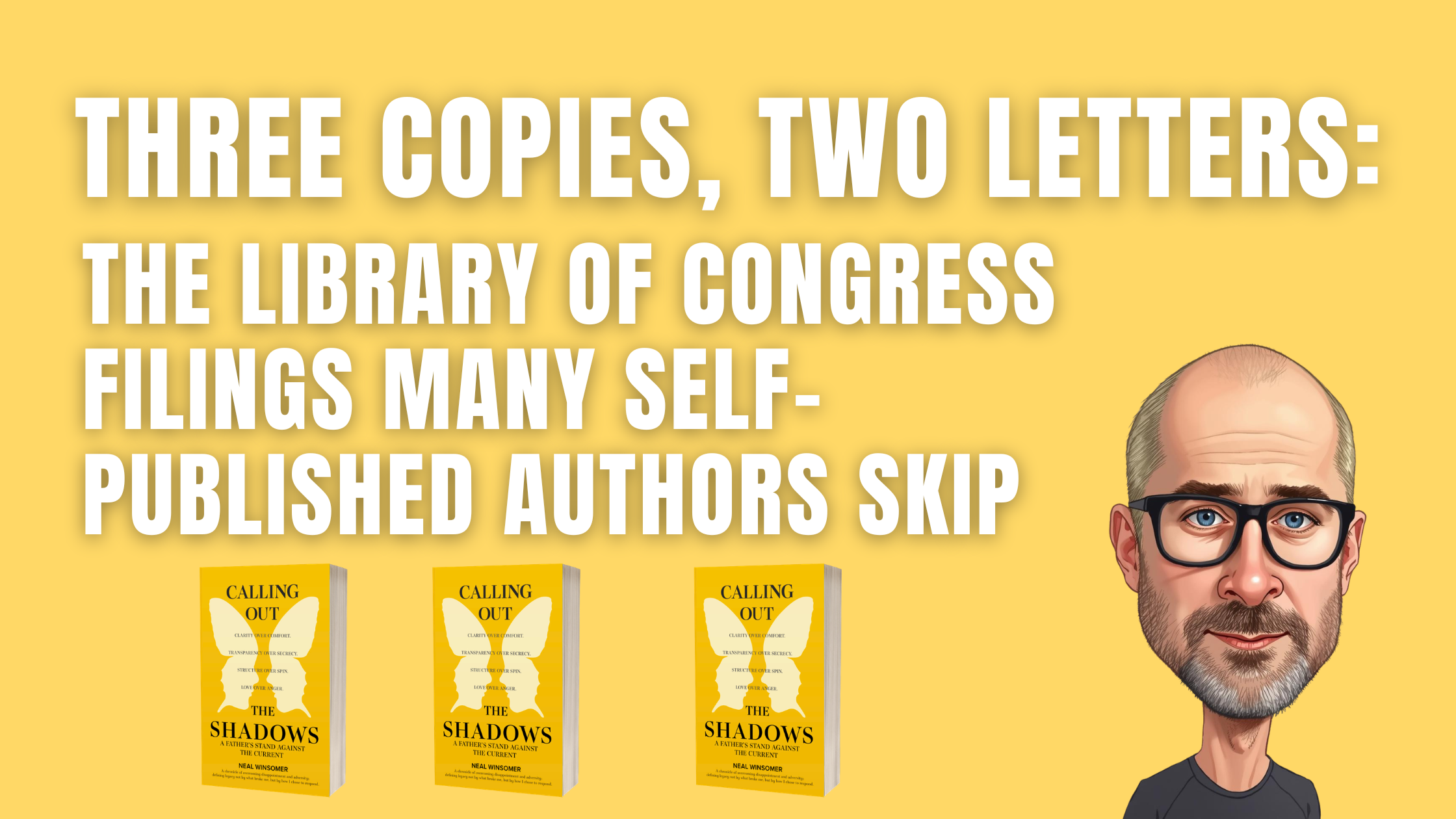
Three Copies, Two Letters: The Library of Congress Filings Many Self-Published Authors Skip
Neal Winsomer
Author of Calling Out the Shadows
Self-Publishing
The two Library of Congress filings many self-published authors skip, the copyright deposit and the LCCN copy, what each one is for, and the order I follow for my own book.
By Neal Winsomer, author and independent publisher
Federal law requires two copies of a book published in the United States to be deposited for the Library of Congress (17 U.S.C. 407). The Library’s catalog program requires a third copy after publication, in return for the control number it preassigned to the book. That is three copies across two separate filings, and many independent authors skip them.
When I publish Calling Out the Shadows, on June 16th 2026, I am sending all three. Here is the order I followed, and why each filing earns its postage.
Three copies, two separate mailings. Both go to the Library of Congress, which is the only reason they get blurred together.
- Two copies of the best edition go to the U.S. Copyright Office.
- One copy goes to the Library’s cataloging division, for the LCCN.
These are two separate filings. Two letters, two boxes, two addresses. Many authors miss one or both.
Why these Library of Congress filings matter
The two copies to the Copyright Office are the mandatory deposit.
The law requires the owner of a published book to deposit two copies of the best edition within three months of publishing (17 U.S.C. 407). A 2023 federal appeals court, in Valancourt Books v. Garland, struck down punishing a publisher purely for skipping that deposit, and the government did not appeal.
So the weight here is not a fine.
It is what registering the copyright gives you in return, and when you register, that one deposit covers both jobs, so it stays two copies, not four.
The one copy to the cataloging division is the condition of the LCCN. The Library assigns that number at no cost, before the book is published, through its Preassigned Control Number program. Once the book is out, you mail one finished copy so the catalog record can be completed.
Why many authors skip it
- Copyright seems automatic, so it is easy to think the job is done. It is not. Registration is the step that unlocks the legal remedies.
- No retailer requires it. KDP and IngramSpark will publish a book without either filing.
- The two tasks look like one. Different divisions, different addresses, different timing.
- The copy can go unmailed, and the catalog record sits open.
I understand why it slips. None of it stands between you and a sale. But the book ends up better protected and easier for libraries to find when you do it, so it is not the place to cut corners.
How I approach it
I treated all of this as following the rules, in order. Each step sets up the next.
- I bought my own ISBNs from Bowker, the only official ISBN agency in the United States, instead of taking the free ones. A free ISBN can list the retailer as the publisher of record and tie the book to that platform. My own ISBNs make my imprint the publisher of record, they can be used on any platform, and they carry across every edition.
- I requested the LCCN before publishing, at no cost, through the Library of Congress PrePub Book Link. It has to happen before the book is out. You need a U.S. publisher, a U.S. place of publication on the copyright page, a book that is not ebook-only, and usually more than 50 pages.
- I registered the copyright through the U.S. Copyright Office at copyright.gov/registration. For a print book you file online, then mail two copies of the best edition. The Best Edition criteria prefer the more durable, archival edition, which ranks a hardbound copy above a softbound one, so if you have both a hardcover and a paperback, send the hardcover. If a paperback is all you have, that is your best edition. That same pair also covers the mandatory deposit. The fee is currently in the 45 to 65 dollar range for an electronic filing. Check the current rate before you file.
- On publication day for Calling Out the Shadows on June 16th, 2026, I am mailing three copies in two separate boxes to two addresses.
Copyright Office, two best-edition copies
Library of Congress
Copyright Office, Attn: 407 Deposits
101 Independence Avenue SE
Washington, DC 20559-6600
Cataloging division, one copy for the LCCN
Library of Congress
U.S. Programs, Law, and Literature Division
Cataloging in Publication Program
101 Independence Avenue SE
Washington, DC 20540-4283
I am sending final published books, not proofs, not Advanced Reader Copies, in two separate boxes to the two addresses. The copies do not come back.
(And how weird is it that the same address has two separate zip codes?)
Why the timing matters
Mail the LCCN copy on publication day, not before.
Sent too early, it arrives while the book is still unpublished, so it does not count.
Sit on it too long and the catalog record stays open.
Publish, then mail.
What it gets you
Two payoffs, one legal and one practical.
The two copies to the Copyright Office come with registering, and registration is what lets you enforce the copyright. Your copyright exists the moment you write the book, but registering it is what lets you take an infringement to court. You can register at any time, even after an infringement, and then act on it.
Register before the infringement, or within three months of publishing, and statutory damages and attorney’s fees are on the table (17 U.S.C. 412). Miss that window and you are limited to actual damages, which are harder to prove.
The one copy to the cataloging division is about discoverability, and here is the part that is easy to misread. Getting the LCCN number is easy and free. Sending the book is what completes the record behind it. Until the Library has a copy in hand, that record stays preliminary.
The copy is what earns your title a full record in the Library of Congress catalog, which feeds the systems libraries use to find and order books, including WorldCat. That record is what makes your book findable to libraries. The number is easy. The book is the part that means something.
Where the rules and the law are written
Each step here traces to a statute, a federal rule, or a government program. Here is where to read them:
- Mandatory deposit, two copies, best edition: 17 U.S.C. 407 and 37 CFR 202.19. Copyright Office Mandatory Deposit page and Circular 7D.
- Where to register: the U.S. Copyright Office registration portal. Registration also covers the mandatory deposit under 17 U.S.C. 408, with the Copyright Office stating the overlap on the Mandatory Deposit page above.
- Best edition, defined: 17 U.S.C. 101, with the criteria in the Copyright Office Best Edition Statement.
- Registration and remedies: 17 U.S.C. 411 and 17 U.S.C. 412, with statutory damages and fees under 504 and 505.
- The free LCCN and the publication-day copy: Library of Congress PCN Program.
- Your own ISBNs and the publisher of record: Bowker, the U.S. ISBN agency.
- The 2023 ruling on the penalty: Valancourt Books v. Garland, 82 F.4th 1222 (D.C. Cir. 2023), where the court threw out fining a publisher just for skipping the deposit, and the government did not appeal.
Here is the run down, in order.
Get your own ISBNs through Bowker.
Get Your copyright registered.
Get Your LCCN through PrePub, before the book is out.
Then two separate mailings on publication day:
two best-edition copies to the Copyright Office,
and one copy to the cataloging division.
Two letters, two places, three copies.
And Scene!
About the author. Neal Winsomer is a father, author, and creator of Protected Narrative Pathway Solutions, a structured approach to helping people share sensitive stories with security and authenticity. He wrote Calling Out the Shadows: A Father’s Stand Against the Current, a memoir and practical guide, and founded Neal Winsomer Publishing LLC, an IBPA member imprint. His work spans consulting, speaking, and strategic guidance for fathers, mothers, family members, family law professionals, and anyone navigating high-conflict communication or working to protect a sensitive narrative.